
Last Updated: May 16, 2026
Garage Door Balance Test & Adjustment in Daly City, CA
An unbalanced garage door puts dangerous strain on springs, cables, and your opener motor, leading to premature failure and expensive repairs. American Garage Door Solutions provides professional balance testing and spring tension adjustment across San Mateo to ensure your door operates safely and efficiently at proper counterbalance.
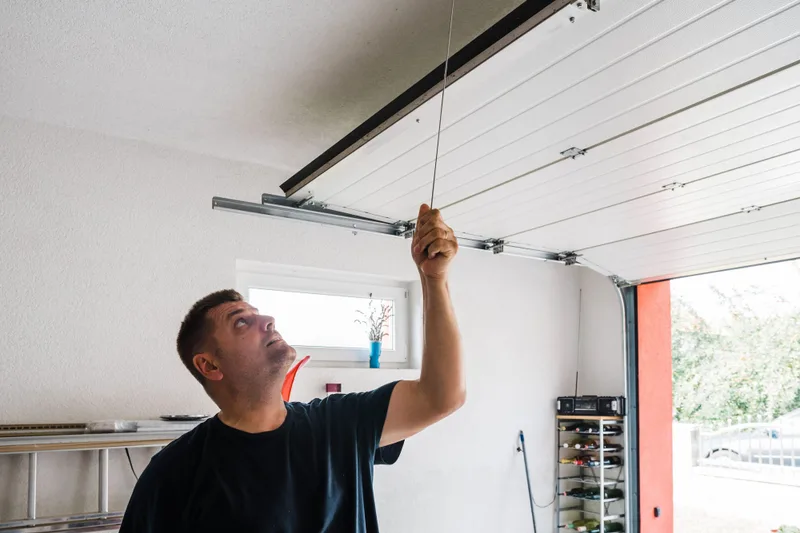
Professional balance testing identifies spring wear before failure
How Much Does a Garage Door Balance Adjustment Cost?
Balance testing and adjustment pricing depends on the scope of work required. Below are current rates for San Mateo and surrounding areas:
| Service | Price Range |
|---|---|
| Balance Test Only | $89 – $109 |
| Balance Test + Spring Adjustment | $109 – $149 |
| Balance + Full Tune-Up | $149 – $199 |
| Emergency Balance Service | $149 – $175 |
All pricing includes the diagnostic test, adjustment labor, and a post-service cycle verification. If we identify additional issues such as a worn spring or frayed cable that requires replacement rather than adjustment, we provide a separate written estimate before proceeding.
How to Test Your Garage Door Balance
Homeowners can perform a basic balance check between professional visits. Follow these steps carefully:
- Close the door completely — Make sure the door is fully shut and resting on the ground with no gaps.
- Pull the emergency release cord — This red cord hanging from the opener rail disconnects the door from the automatic opener, allowing manual operation.
- Manually lift the door to the halfway point — Grasp the door handle or bottom edge and lift it approximately four feet off the ground to the midpoint of the track.
- Release the door carefully — Let go slowly and step back. Watch what the door does over the next few seconds.
- Evaluate the result — A properly balanced door stays in place at the halfway point, hovering without moving up or down. If the door rises, your springs have too much tension. If it falls, your springs have too little tension and are not adequately counterbalancing the door's weight.
Important safety warning: Do NOT attempt to adjust spring tension yourself. Torsion springs store extreme force and require professional winding bars and training to modify safely. If your door fails this test, call American Garage Door Solutions at (650) 835-1803 for professional adjustment.
What Causes an Unbalanced Garage Door?
Several factors can push your garage door out of balance over time. Understanding these causes helps you recognize when professional service is needed:
- Worn or aging springs losing tension — Garage door springs are rated for a specific number of cycles (typically 10,000 to 20,000). As they fatigue through daily use, they gradually lose their ability to hold proper tension, causing the door to become heavier on one side or overall. This is the most common cause of gradual imbalance.
- Temperature changes causing expansion and contraction — Metal springs respond to temperature fluctuations. Cold weather causes springs to contract and stiffen, while heat makes them expand and become more flexible. The Bay Area's temperature variation between cool mornings and warm afternoons creates ongoing stress on spring calibration.
- Broken spring causing sudden imbalance — When one spring in a two-spring system breaks, the remaining spring cannot support the door's full weight alone. This creates immediate, dramatic imbalance and usually makes the door impossible to open manually. A broken spring requires immediate spring replacement rather than adjustment.
- Cable stretched or unwound from drum — Lift cables can stretch over time or come unwound from the cable drum due to vibration or improper winding. When one cable is longer than the other, the door lifts unevenly and puts lateral stress on the tracks and rollers.
- Track misalignment — If vertical or horizontal tracks shift out of alignment from impact or loosened brackets, the door encounters resistance at certain points in its travel, creating the sensation of imbalance even when spring tension is correct.
- Bent or damaged panels adding weight unevenly — A dented or warped panel changes the door's weight distribution. Vehicle impacts, storm damage, or deterioration can add drag on one side, requiring spring recalibration to compensate for the altered load.
- Previous improper spring installation — If springs were installed without proper calibration for your specific door weight and height, the imbalance may have existed from day one and gradually worsened as the incorrectly tensioned springs fatigued faster than expected.
Dangers of an Unbalanced Door
Operating an unbalanced garage door is not just inconvenient—it creates serious safety and financial risks that compound over time:
- Opener motor burnout — Your garage door opener is designed to work with a balanced door where the springs carry the weight. When the door is unbalanced, the motor works against gravity every cycle, drawing excessive amperage that overheats internal components. This shortens a $300 to $500 opener's lifespan from 15 years to as few as 3 to 5 years.
- Cable snapping under uneven load — Imbalance forces one cable to bear more weight than engineered. The overloaded cable develops micro-fractures in its steel strands, eventually snapping without warning. A broken cable under tension can whip with enough force to cause lacerations or eye injuries.
- Door falling unexpectedly — A severely unbalanced door with weakened springs can drop without warning when disconnected from the opener. A standard residential garage door weighs 150 to 400 pounds—enough to crush bones, total a vehicle hood, or fatally injure a child or pet beneath it.
- Warped tracks from lateral stress — When the door pulls unevenly, it generates side-loading forces that bend tracks outward over time. Warped tracks eventually cause the door to jump off track entirely, requiring expensive track repair or replacement.
- Shortened spring life — Springs operating outside their designed tension range fatigue at an accelerated rate. A spring rated for 15,000 cycles may fail at 8,000 cycles when chronically over- or under-tensioned, doubling your long-term spring replacement costs.
- Higher energy bills — An opener straining against an unbalanced door draws significantly more electricity per cycle. For a door that opens four or more times daily, this excess power consumption adds measurable cost to your monthly energy bill.
Our Balance Adjustment Process
American Garage Door Solutions technicians follow a precise, multi-step protocol to diagnose and correct garage door balance issues:
- Disconnect door from opener — We disengage the automatic opener to isolate the door's mechanical balance from any motor assistance, allowing accurate measurement of spring counterbalance alone.
- Manual balance test at multiple positions — Unlike a simple halfway test, we evaluate balance at one-quarter, one-half, and three-quarter open positions. A properly calibrated door should hold steady at all three points, not just the middle.
- Spring tension measurement — Using calibrated torque tools, we measure the exact tension in each torsion spring or the stretch in extension springs to identify which spring needs adjustment and by how much.
- Calculated adjustment — Based on measurements, we calculate the precise number of quarter-turns needed on each spring to achieve proper counterbalance. We add or remove turns using professional winding bars with controlled, incremental adjustments.
- Re-test at one-quarter, one-half, and three-quarter positions — After adjustment, we verify the door holds steady at all three test points. If any position shows drift, we fine-tune further until balance is achieved throughout the full range of travel.
- Reconnect opener — We re-engage the automatic opener trolley and verify proper connection between the opener arm and the door bracket.
- Cycle test five or more times — We run the door through at least five complete open-close cycles using the opener to verify smooth, consistent operation under powered conditions with no hesitation, jerking, or uneven speed.
- Verify auto-reverse function still calibrated — Spring tension changes can affect the opener's force settings. We test the safety reversal mechanism to confirm the door still reverses on obstruction contact and that photo-eye sensors trigger properly.
How Often Should You Test Door Balance?
Maintaining proper garage door balance requires both homeowner awareness and periodic professional service:
- Monthly visual check — Watch your door during normal operation. Does it hesitate at any point during opening? Does it slam closed faster than usual? Does the opener sound strained or vibrate excessively? These are early indicators that balance has shifted and professional testing is warranted.
- Professional test annually — Schedule a professional balance assessment as part of your yearly garage door maintenance. Technicians detect subtle imbalances at multiple positions that a homeowner visual check cannot identify.
- Immediately after any spring service — Whenever springs are repaired, replaced, or adjusted, a comprehensive balance verification should follow to confirm the new or modified springs are properly calibrated for your door's weight.
- After panel replacement — New panels may differ slightly in weight from the originals they replace. Even a few pounds of difference requires spring recalibration to maintain proper counterbalance across the door's full travel range.
- After any impact — If a vehicle backs into the door, a heavy object strikes a panel, or storm debris causes damage, test the balance immediately. Impact can bend components, shift track alignment, or alter the door's weight distribution in ways that stress the entire system.
Frequently Asked Questions
How do I know if my garage door is unbalanced?
Disconnect your opener by pulling the emergency release cord, then manually lift the door to the halfway point (about four feet) and release it carefully. A balanced door stays in place without moving. If it rises, the springs are too tight. If it falls, the springs are too loose. Other warning signs include your opener straining or vibrating excessively, uneven movement during opening or closing, and the door slamming shut faster than normal.
Can I adjust garage door balance myself?
No. Balance adjustment requires changing spring tension, which involves extreme force measured in hundreds of pounds. Torsion springs store enough energy to cause serious injury or death if they release unexpectedly during improper adjustment. Extension springs under tension can fly off their mounting brackets with lethal velocity. Always hire a trained professional with proper winding bars and experience to adjust garage door spring tension safely.
How often should garage door balance be checked?
Test your door balance monthly yourself by disconnecting the opener and lifting the door halfway to see if it stays in place. Have a professional calibration performed annually as part of your regular maintenance service, or immediately after any spring work, cable repair, panel replacement, or impact to the door system.
What happens if you don't fix an unbalanced garage door?
Your opener motor burns out prematurely because it works against gravity instead of being assisted by properly tensioned springs. Springs fail sooner due to uneven stress distribution. Cables can snap under asymmetric loading. Most critically, the door may fall unexpectedly—at 300 or more pounds, a falling garage door presents a serious crushing hazard to people, pets, and vehicles positioned beneath it.
Does weather affect garage door balance?
Yes, temperature changes cause metal springs to expand and contract slightly, which directly changes their tension characteristics. Cold temperatures make springs stiffer while heat makes them more flexible. The Bay Area's temperature swings between seasons, combined with the difference between cool coastal mornings and warm afternoons, can gradually shift your door's balance over time. This natural drift is one reason annual professional calibration is recommended.
Why Choose American Garage Door Solutions for Balance Adjustment
American Garage Door Solutions brings precision tools and deep experience to every balance adjustment. Our technicians work with all door weights and types—from lightweight single-car aluminum doors to heavy insulated double-car steel and wood composite doors weighing 400 pounds or more. We carry calibrated torque measurement equipment that eliminates guesswork from spring adjustment.
We offer same-day balance adjustment for most calls received before noon. Our honest assessment policy means we will not recommend a full spring replacement if a simple tension adjustment resolves your imbalance. Many competitors default to selling new springs because it generates higher revenue, but American Garage Door Solutions prioritizes the repair that actually solves your problem at the lowest appropriate cost.
Every balance service includes our multi-position verification protocol, cycle testing, and safety system check. We document our findings and adjustments so your door's service history is available for future reference during annual maintenance visits.